
Differences in Computational Asset IoT Technology and ValueI will analyze two U-Position asset IoT technologies—EIC technology and MC-RFID technology across multiple dimensions including technical architecture, real-time performance, accuracy, reliability, standardization, and industry chain, for your company’s future project technology selection reference. Requirements from Fortune 500 users for related technologies and products: positioning accuracy at the U-Position level, real-time performance (≦3 seconds), accuracy of location data (≧99.9999%), sensor reliability of 100,000 hours maintenance-free, and system availability for continuous operation 24/7 for 10 years. Only by meeting these performance indicators can value be created for users. The early U-Position asset tags were designed using the EIC technology architecture, based on the 1-Wire technology from the 1980s. Due to the inherent flaws of the single-bus technology, there are issues such as slow response speed, poor anti-interference capability, and the connection between each electronic tag and the U-Position asset tag relying on four electrical contact points. Generally, after 1-2 years of use, contact points become oxidized, and dust and vibrations from fans lead to poor connectivity, resulting in a significant number of false reports. This adversely affects the user experience, and problems such as discrepancies between the accuracy of location data and the actual condition of physical assets are becoming increasingly frequent. To address the above issues, I invented the magnetic field positioning-based RFID technology MC-RFID, which has been granted invention patents in China and the United States, as well as the National Data Center Science and Technology Achievement Progress Award. The positioning accuracy reaches over 99.9999%, the sensor lifespan can exceed 10 years, and it has the advantage of being maintenance-free, making it the world’s first and currently the only advanced technology capable of meeting large-scale commercial applications. This innovative technology, after more than 10 years of practice, has now been adopted by multiple Fortune 500 companies worldwide and has received the best customer experience. 1. Differences in U-Position Asset Bar Technology Architecture(1) The EIC asset tag adopts a single bus architecture, where a single MCU monitors 42 electronic tags through a single communication bus, as shown in the figure below. 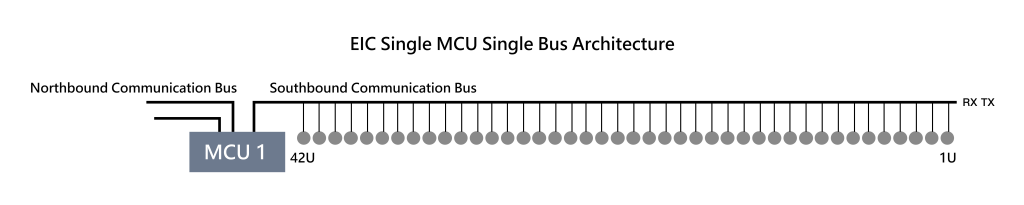 The MC-RFID asset tag employs a distributed MCU technology architecture, where one MCU monitors six MCUs through a bidirectional communication bus. Each MCU monitors six Hall sensors on its I/O ports in real-time via its own I/O bus. Once a Hall sensor is triggered by a tag, it automatically activates the RFID sensor at the corresponding U-Position to exchange data with the MC-RFID tag. After the data exchange is complete, the RFID sensor is automatically turned off. The sensing and positioning process is entirely managed by the internal MCU. Real-time positioning messages are obtained by MCU1 from MCU2 to MCU7 via the southbound dual bus, while the gateway retrieves all messages from the seven MCUs in real-time through the northbound bus of MCU1. As shown in the figure below. 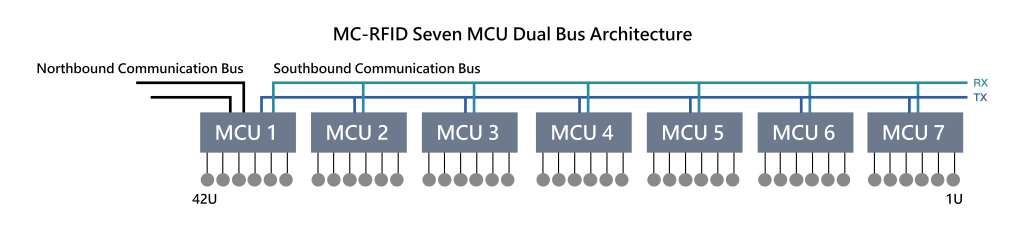 2.Differences in the Technical Architecture of U-Position Real-Time Location Sensors(1) EIC sensors are contact electronic tags based on 1-Wire single bus technology (which originated in the 1980s). They use mechanical contact positioning and have a protection level of IP20. This protection level indicates poor environmental adaptability, with a typical lifespan of 1-2 years, during which issues such as oxidation, dust, and vibration can lead to false alarms. They are only suitable for scenarios with relatively low availability requirements. (2) MC-RFID sensors, which emerged from IoT technology in 2015, consist of four highly available intelligent sensors for each U-Position. This configuration reduces the impact of single points of failure and enhances system redundancy. The sensors utilize non-contact magnetic field positioning technology combined with RFID (Radio Frequency Identification) technology, have a protection level of IP65, and boast a lifespan of over 10 years, offering high availability and maintenance-free advantages.
3.Real-time performanceReal-time performance refers to the total time taken from the moment the sensor collects the asset’s location data to when this information is displayed on the user-end software interface. If this time is within 3 seconds, users consider it a real-time asset tracking system. This requirement for real-time performance must be met whether counting 10,000 assets or 1,000,000 assets.
4. AccuracyThe accuracy of U-Position asset sensor location data reflects the ability to collect real-time location information of assets on-site, which is the foundation for achieving consistency between asset records and physical counts.
5. ReliabilityReliability refers to the adaptability of U-Position assets and U-level Tags to the environment during use, and whether they can consistently create value for users when facing the challenges of complex working environments throughout their entire lifecycle.
6. Usability
7. Industry Chain
SummaryThe MC-RFID asset real-time tracking system comprehensively surpasses the EIC asset positioning system in terms of real-time performance, accuracy, reliability, and scalability, making it an advanced technology that can truly help your company achieve its target value.
Article classification:
News
|

;)
;)
 |