
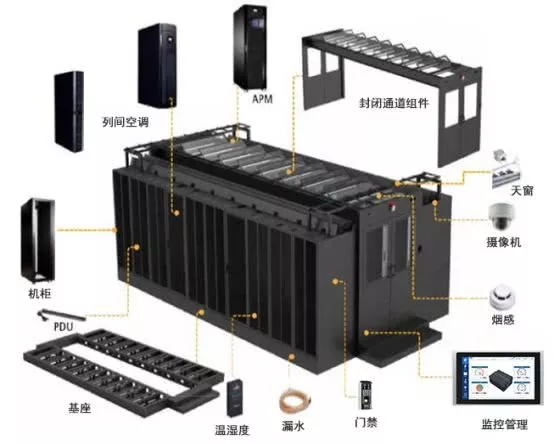
The micro-module combined with U-bit management technology leads the new trend of data center develoUnder the promotion of cloud computing and big data applications, data center construction has ushered in a new construction climax, in the face of such a huge market, traditional data centers are "solid", slow deployment, low density, lack of flexibility and scalability. Moreover, the server is strictly bound to auxiliary modules such as power supply and refrigeration, which makes expansion difficult and involves the whole body. In the later stage, with the development of business and the increase of applications, the data center system needs more management software, and the system is becoming more redundant, and the power distribution and refrigeration can no longer meet the needs. At this time, the overall system has to be redesigned and expanded. In this context, the micro-module data center came into being, it is in accordance with industry standards for the data center site micro-module division, that is, the entire data center is divided into several independent areas, the scale of each area, power load, configuration, etc. are designed in accordance with unified standards, do not interfere with each other, can operate independently, no shared part.
Micromodules bring a number of advantages to the data center: (1) Rapid deployment and shorter construction cycle (2) Standard module, stable and reliable (3) Easy to expand and stage construction (4) Intelligent management and efficient operation (5) Green, energy saving At the same time of the development of micro-module data centers, IT asset management technology is also constantly updated and iterated, from the initial cabinet level asset management to the U-level asset management that is more popular in the industry today. Compared with rack-level asset management, you only know what assets are in the cabinet, but you do not know the specific distribution of assets.
The rise and development of U-level asset management technology has further improved the precision of management, directly positioning each asset to the corresponding U-bit, and realizing real-time asset positioning, automatic change, capacity management and other functions. In particular, the invention of MC-RFID technology solves the disadvantages of traditional RFID technology that is prone to misreading and missing reading, realizes 100% accuracy of asset data, and promotes the large-scale use of U-bit technology in the data center industry. U-bit asset management technology brings a number of advantages to the data center: The combination of U-level asset management technology and micro-module has opened up the last kilometer of micro-module management, combined with the current micro-module dynamic loop monitoring system, to achieve real-time management of core IT assets in the micro-module, which is the common practice of many micro-module manufacturers, and even become a bright spot in the fierce competition situation of micro-modules.
Article classification:
News
|

;)
;)
 |